

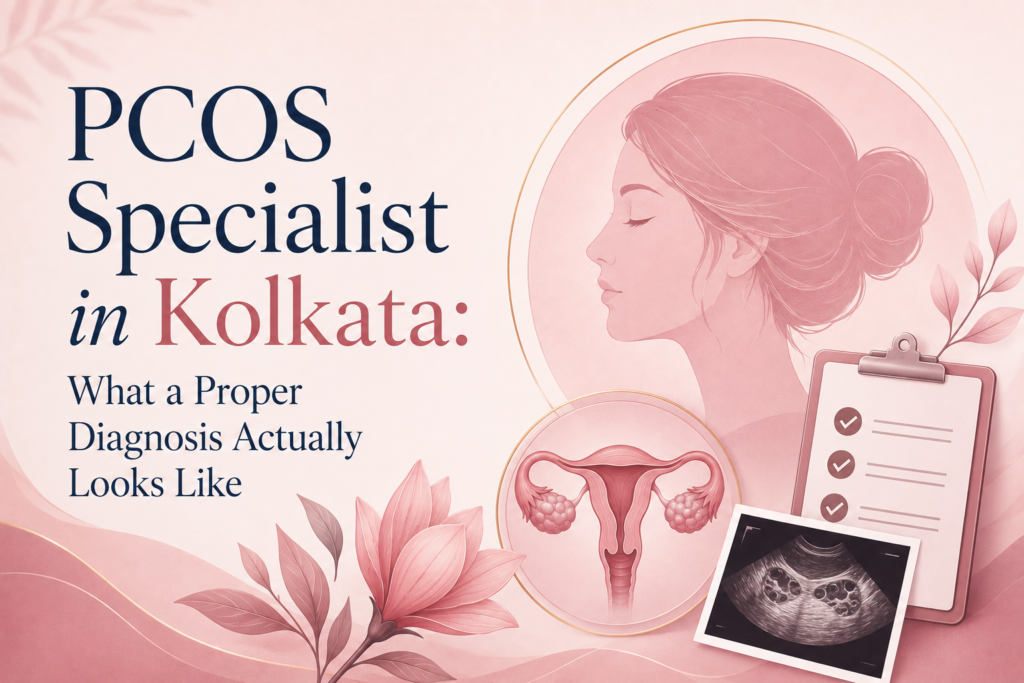
PCOS is one of the most common endocrine conditions in women of reproductive age, affecting somewhere between 8 and 13 percent of the population depending on which diagnostic criteria you use. It is also one of the most variably managed conditions in gynaecological practice. Some women are diagnosed in 10 minutes and sent away with metformin. Others spend years cycling through diagnoses — thyroid disorder, depression, insulin resistance, unexplained infertility — without anyone connecting the dots.
If you are searching for a PCOS specialist in Kolkata, this guide explains what a thorough diagnosis looks like, what questions to ask, and what distinguishes adequate management from the kind that actually changes your long-term health trajectory.
What PCOS is and what it is not
PCOS (polycystic ovary syndrome) is a hormonal and metabolic disorder characterised by at least two of three features under the Rotterdam Criteria: irregular or absent ovulation, clinical or biochemical signs of excess androgens (testosterone, DHEAS), and polycystic ovarian morphology on ultrasound. You do not need all three to have PCOS. You do not need cysts on your ovaries to have PCOS. Many women are misdiagnosed with PCOS based on an ultrasound alone, which is insufficient.
What PCOS is not: it is not simply irregular periods. It is not a “lifestyle problem” that goes away with weight loss (weight gain is often a consequence of PCOS, not just a cause of it). It is not infertility by itself, though it is the most common cause of anovulatory infertility. And it is not the same condition in every woman, which is why management must be individualised.
What a proper PCOS workup looks like
A thorough first assessment for suspected PCOS should include the following. If your consultation did not cover most of this, you may not have had a proper diagnostic workup.
Full hormonal panel. LH, FSH, LH:FSH ratio, total testosterone, free testosterone, DHEAS, SHBG, prolactin, AMH. This tells you whether the androgen excess is of ovarian or adrenal origin, whether ovulatory function is suppressed, and what the ovarian reserve looks like. AMH is particularly useful in PCOS because it is typically elevated and correlates with the degree of follicular arrest.
Thyroid function. TSH and free T4. Hypothyroidism and subclinical hypothyroidism produce PCOS-like symptoms (weight gain, irregular periods, fatigue) and can coexist with PCOS or mimic it. A TSH is not optional in the workup.
Fasting insulin and fasting glucose. PCOS is associated with insulin resistance in approximately 50 to 70 percent of cases, regardless of body weight. This means lean women with PCOS can have significant insulin resistance that is not visible on a standard glucose tolerance test. Fasting insulin quantifies this. HOMA-IR (calculated from fasting insulin and glucose) is the standard index.
Lipid profile. PCOS carries an elevated long-term cardiovascular risk. A baseline lipid profile is part of proper initial assessment.
Pelvic ultrasound. Transvaginal ultrasound is more sensitive than abdominal ultrasound for assessing ovarian morphology. The Rotterdam criteria define polycystic ovarian morphology as 12 or more follicles measuring 2 to 9 mm in one or both ovaries, or ovarian volume greater than 10 ml. These are specific thresholds, not a general impression of “many cysts.”
Clinical assessment of androgen excess. Hirsutism (excess body or facial hair), acne, and alopecia are clinical signs of hyperandrogenism. The modified Ferriman-Gallwey score is used to quantify hirsutism. This takes two minutes in a consultation and should be done as part of the examination.
Why most PCOS consultations in Kolkata fall short
The typical PCOS consultation goes like this: you report irregular periods and weight gain, the doctor orders a pelvic ultrasound, the report mentions “polycystic ovaries,” and you are prescribed metformin with a recommendation to exercise and lose weight.
This is not a diagnosis. It is pattern recognition at a surface level, without confirming whether you have anovulation, without measuring androgen levels, without checking insulin resistance, without assessing thyroid function, and without a baseline cardiovascular risk profile.
The consequences are real. Women with unrecognised insulin resistance who are managed only with metformin and lifestyle advice do not get the full benefit that could come from a more targeted approach. Women whose hirsutism is driven by adrenal androgen excess rather than ovarian androgen excess need a different treatment pathway. Women who are told to “just lose weight” when their PCOS is driving weight gain through insulin resistance are being given circular advice.
A PCOS specialist, as opposed to a general gynecologist managing PCOS cases, understands these distinctions and builds a management plan that accounts for your specific hormonal pattern, your insulin sensitivity, your fertility goals, and your long-term metabolic risk.
Long-term PCOS management: what it should include
PCOS does not go away after the reproductive years. It is associated with an elevated lifetime risk of type 2 diabetes, cardiovascular disease, non-alcoholic fatty liver disease, and endometrial cancer (from unopposed oestrogen in anovulatory cycles). Long-term management should address all of these.
For women not trying to conceive: hormonal regulation (combined oral contraceptive pill or cyclic progesterone to protect the endometrium), management of androgen excess symptoms (pill with anti-androgenic profile, or spironolactone where appropriate), and monitoring of metabolic markers annually.
For women trying to conceive: ovulation induction (letrozole is now first-line over clomiphene, per updated FOGSI and ESHRE guidelines), with monitoring. IUI where indicated. IVF only when simpler interventions have not achieved pregnancy after appropriate duration.
For all women with PCOS: dietary assessment (low glycaemic index diet reduces insulin resistance independently of caloric restriction), exercise prescription (resistance training and aerobic exercise both improve insulin sensitivity), and at minimum annual monitoring of fasting glucose, lipids, and blood pressure.
Consulting a PCOS specialist in Kolkata
Dr. Juhi Dhanawat is a female gynecologist consulting in Kolkata at four locations. She manages PCOS with full hormonal workup, insulin sensitivity assessment, and individualised management covering both the reproductive and metabolic dimensions of the condition.
Clinics: Neotia Bhagirathi Rawdon Street (Tue/Sat 5 to 7 PM), Neotia Bhagirathi New Town (Thu/Sun 9:30 to 11:30 AM), Motherhood Hospital Kasba, R N Tagore EM Bypass (Wed 10 AM to 12:30 PM).
Appointment: +91 8240886334 | drjuhidhanawat.in/book-anappointment