

Intrauterine insemination — IUI — occupies the middle ground between natural conception attempts and IVF in the fertility treatment ladder. It is less invasive, less expensive, and less physically demanding than IVF. For couples who qualify, it offers a meaningful improvement in conception chances per cycle. For couples who do not qualify, pursuing multiple IUI cycles before moving to IVF delays effective treatment without improving outcomes.
Understanding exactly what IUI involves, who it is appropriate for, what success rates realistically look like, and when IVF is the better first choice is essential for any couple navigating fertility treatment in Kolkata.
What IUI Involves
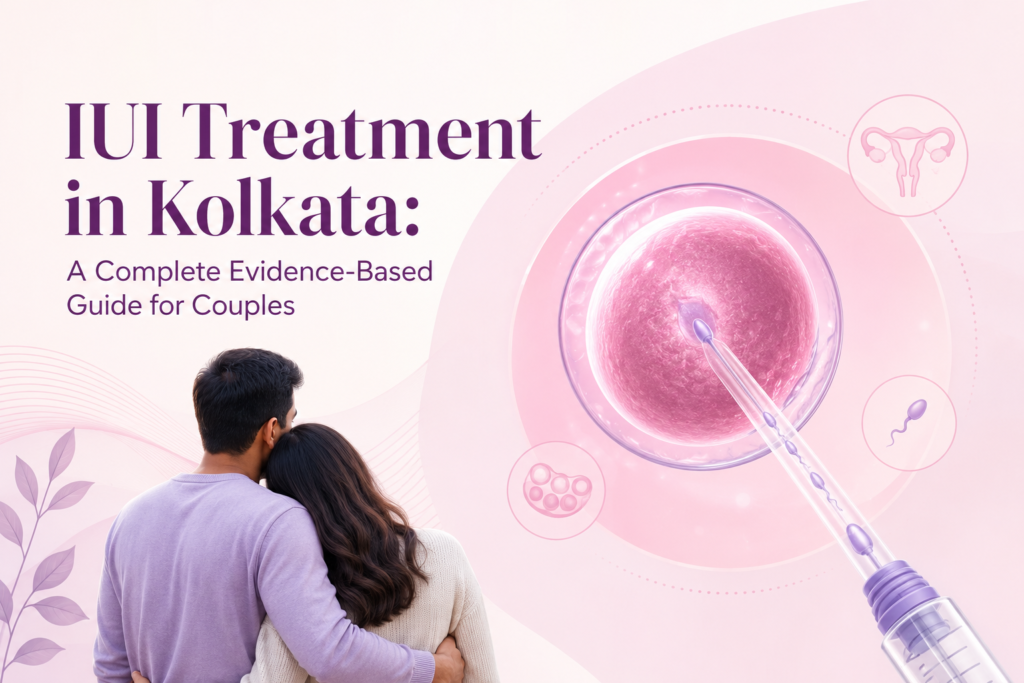
Intrauterine insemination places a prepared sperm sample directly into the uterine cavity via a thin catheter, at or around the time of ovulation. The process bypasses the cervical environment — which can be hostile to sperm in certain conditions — and deposits sperm closer to the fallopian tubes where fertilisation occurs.
The IUI cycle protocol:
Natural cycle IUI — performed in a natural menstrual cycle, with serial ultrasound monitoring to detect natural ovulation and a trigger injection to time the insemination precisely. Suitable for women with regular ovulatory cycles.
Stimulated IUI — ovulation induction with low-dose gonadotropins (FSH injections) or clomiphene citrate, combined with serial monitoring. The goal is 2-3 mature follicles to improve per-cycle chance. This approach requires careful monitoring to prevent higher-order multiple pregnancies (triplets or more), which is a significant risk of unmonitored stimulated IUI.
The sperm preparation: The semen sample is processed in the laboratory — sperm are washed, concentrated, and prepared to separate motile sperm from seminal plasma. The final prepared volume of 0.3-0.5 ml containing a high concentration of motile sperm is loaded into a fine catheter and passed through the cervix into the uterine cavity. The procedure takes approximately 2-3 minutes and is described as comparable to a Pap smear.
Who Is IUI Appropriate For?
IUI produces meaningful outcomes in carefully selected cases:
Unexplained infertility in women under 35 — couples who have been trying to conceive for 12 months (or 6 months if over 35), have patent fallopian tubes on HSG or laparoscopy, a normal uterine cavity, normal ovarian reserve, and a sperm count above 5-10 million motile sperm post-wash. In this group, 3-4 stimulated IUI cycles produce cumulative success rates of approximately 40-50%.
Mild male factor infertility — total motile sperm count between 5-20 million post-wash. Below 5 million post-wash, IVF with ICSI is more appropriate.
Cervical factor — abnormal cervical mucus or anti-sperm antibodies at the cervix. IUI bypasses the cervix entirely.
Donor sperm insemination — IUI is the standard method for insemination with donor sperm.
Ovulation disorders — women with irregular or absent ovulation (from PCOS or other causes) who have other factors in the normal range. PCOS-related anovulation is one of the most common indications.
When IUI Is NOT Appropriate
Tubal factor infertility — if one or both fallopian tubes are blocked or damaged (from PID, endometriosis, or previous surgery), IUI sperm cannot reach the egg through a damaged tube. IVF is required.
Severe male factor — post-wash motile count below 5 million. IVF with ICSI is more effective.
Moderate-severe endometriosis — endometriosis stages III-IV significantly reduce IUI success rates to near-zero in many series. IVF is the appropriate approach.
Advanced maternal age (over 38-40) — ovarian reserve declines rapidly. Spending 3-4 cycles on IUI before moving to IVF loses critical time. Discussion with a fertility specialist is essential to determine whether a brief IUI attempt is appropriate or whether proceeding directly to IVF is more time-effective.
Recurrent IUI failure — after 3-4 failed IUI cycles in a well-selected patient, IVF offers significantly higher success rates. Continuing IUI beyond 4 cycles has limited evidence support.
Success Rates — Realistic Expectations
IUI success rates per cycle range from approximately 8-15% for natural cycle IUI to 12-20% for stimulated IUI in well-selected patients. Cumulative success after 3-4 cycles reaches approximately 40-50% in optimal candidates.
These rates decline with:
- Female age (particularly above 38)
- Lower post-wash sperm count
- Longer duration of infertility
- Endometriosis
- Diminished ovarian reserve
Success rates significantly ABOVE these ranges quoted by some clinics warrant scrutiny — they may reflect selected patient populations, measurement methodology differences, or inaccurate reporting.
IUI vs IVF: The Decision Framework
For couples uncertain about whether IUI or IVF is the appropriate starting point, the key clinical questions are: Are both tubes open? Is the post-wash sperm count above 5 million? Is ovarian reserve adequate? Is there moderate-severe endometriosis? Is the woman under 38?
If all five answers are favourable, a short course of IUI (2-4 cycles) is a reasonable first step. If any answer is unfavourable — particularly blocked tubes, severe male factor, or significant endometriosis — IVF should be the starting treatment, not IUI after months of delay.
For comprehensive fertility evaluation, gynaecological assessment, endometriosis investigation, and consultation at Neotia Bhagirathi, Rawdon Street and New Town, and Motherhood Hospital, Kasba are available.
Frequently Asked Questions
Q: How many IUI cycles should I try before moving to IVF?
A: Evidence supports 3-4 IUI cycles in well-selected patients before recommending IVF. After 4 failed cycles, the cumulative chance of success with additional IUI cycles is low while IVF offers substantially higher per-cycle success rates.
Q: Is IUI painful?
A: The procedure itself is brief (2-3 minutes) and comparable to a Pap smear. Some women experience mild cramping during or after. Most return to normal activity immediately.
Q: Does IUI increase the risk of twins?
A: Natural cycle IUI has a twin risk similar to spontaneous conception. Stimulated IUI increases the risk of multiple pregnancies (twins and higher) — careful monitoring to limit the number of mature follicles before triggering is essential to minimise this risk.
Q: What is the cost of IUI treatment in Kolkata?
A: A single IUI cycle including monitoring scans and the procedure typically costs 15,000-25,000 rupees depending on whether stimulation medications are included. This is significantly lower than IVF. However, if 3-4 cycles are needed, the cumulative cost approaches a single IVF cycle.
Q: Can IUI work if I have PCOS?
A: Yes — PCOS-related anovulation is one of the primary indications for stimulated IUI. Ovulation induction restores regular ovulation, and IUI times insemination precisely. Success rates are comparable to the general IUI population in well-selected PCOS patients.
Book: Call +91 8240886334 or visit drjuhidhanawat.in/book-anappointment/
INTERNAL LINKS: endometriosis and infertility | PCOS treatment | PID treatment | gynaecology services | obstetrics
EXTERNAL LINKS: Neotia Bhagirathi | Motherhood Hospital | ICMR ART guidelines