

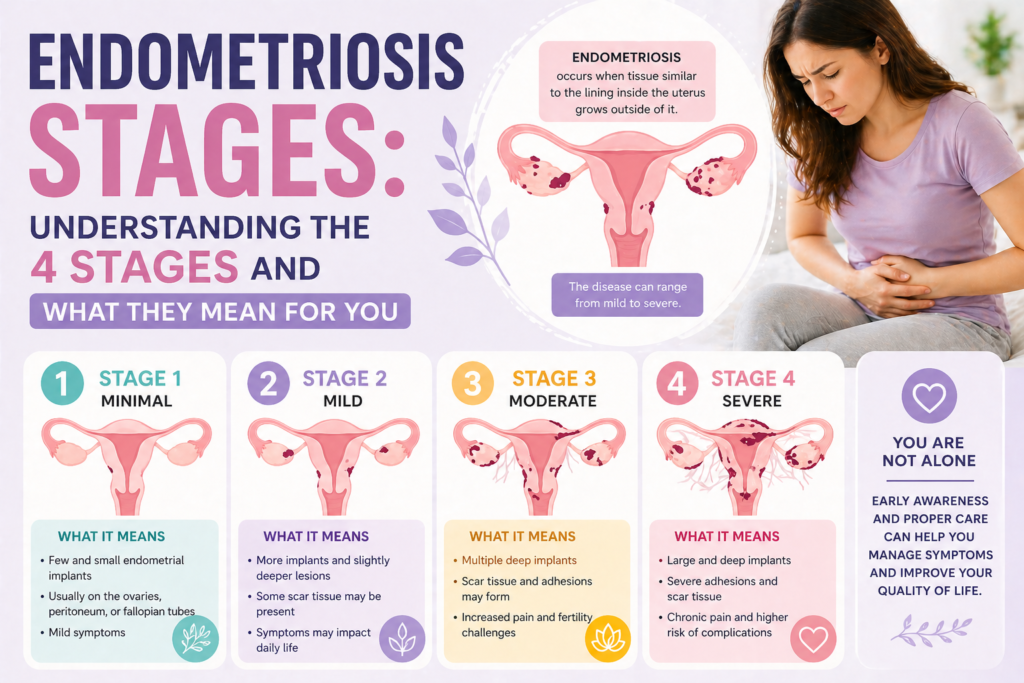
If you have been diagnosed with endometriosis — or suspect you have it — you have probably heard about endometriosis stages. But what do they actually mean? Does a higher stage mean more pain? Does Stage 1 mean you do not need treatment?
Here is the truth: the 4 endometriosis stages classify the EXTENT of disease, not the severity of your symptoms. A woman with Stage 1 can have debilitating pain, while a woman with Stage 4 may have minimal symptoms. Understanding your stage helps your endometriosis specialist plan the right treatment — but it does not define your experience.
The 4 Endometriosis Stages (ASRM Classification)
The American Society for Reproductive Medicine classifies endometriosis stages based on the location, depth, and extent of endometrial implants, adhesions, and ovarian involvement.
Stage 1 — Minimal: Small, superficial implants on the pelvic lining. Minimal or no adhesions. Often found incidentally during surgery for other reasons. Can still cause significant pain despite the “minimal” label.
Stage 2 — Mild: More implants that are deeper than Stage 1. May have some mild adhesions. Still relatively limited in spread but symptoms can be moderate to severe.
Stage 3 — Moderate: Deep implants on the ovaries and pelvic lining. Endometriomas (chocolate cysts) may be present on one or both ovaries. Adhesions are more significant, potentially affecting the tubes and ovaries.
Stage 4 — Severe: Extensive deep implants and large endometriomas. Dense adhesions may distort pelvic anatomy — tubes, ovaries, and bowel may be stuck together. May involve the bowel, bladder, or pelvic nerves. This is deep infiltrating endometriosis.
Why Stage Does NOT Equal Pain
This confuses many patients and even some doctors. You would expect Stage 4 to be the most painful and Stage 1 to be painless. But it does not work that way.
Pain depends on WHERE the endometriosis is, not how much there is. A tiny implant on a nerve can cause excruciating pain. A large endometrioma on the ovary may cause no pain at all. Deep implants near the bowel or bladder cause symptoms related to those organs. Nerve involvement causes burning, shooting, or electric pain that standard painkillers cannot touch.
This is why seeing a specialist matters more than knowing your stage number.
Treatment by Stage
Stage 1-2: Medical management with hormonal therapy is often the first approach. If pain persists or fertility is a concern, laparoscopic excision surgery to remove implants can provide significant relief and improve conception chances.
Stage 3-4: Surgery is usually recommended — particularly for endometriomas and significant adhesions. The surgeon’s expertise directly impacts outcomes. Excision surgery (cutting out tissue) is superior to ablation (burning). For deep infiltrating endometriosis involving the bowel or nerves, a specialist with neuropelveology training can perform nerve-sparing surgery that preserves bladder and sexual function.
All stages: Lifestyle modifications, pain management, hormonal therapy, and regular monitoring are part of ongoing care regardless of stage.
When Endometriosis Involves the Nerves
In severe cases, endometriosis can grow directly onto the sacral plexus or sciatic nerve — causing leg pain, sciatica during periods, and progressive nerve damage. This does not show up on standard ultrasound. It requires a neuropelveology specialist trained in pelvic nerve examination.
Dr. Juhi Dhanawat holds both a Fellowship in Endometriosis from France and a Masters in Neuropelveology from Switzerland. This means she can treat all 4 endometriosis stages — including the most complex cases involving nerves that most gynecologists in Kolkata are not equipped to handle. She practices at Neotia Bhagirathi, Rawdon Street and New Town, and Motherhood Hospital, Kasba, Kolkata.
Frequently Asked Questions
Q: Can endometriosis stage change over time? A: Yes. Without treatment, endometriosis can progress from a lower to higher stage. However, progression is not guaranteed — some women remain at the same stage for years. Treatment and hormonal management can slow or prevent progression.
Q: Does Stage 1 endometriosis need treatment? A: If it causes symptoms — pain, heavy periods, or difficulty conceiving — yes. The stage number does not determine whether treatment is needed. Your symptoms and quality of life do.
Q: Can Stage 4 endometriosis be treated without hysterectomy? A: Yes. Expert laparoscopic excision surgery can remove even extensive Stage 4 disease while preserving the uterus and fertility. Hysterectomy is a last resort, not a first-line treatment for endometriosis.
Q: Which stage of endometriosis causes infertility? A: All stages can affect fertility, but Stage 3-4 with ovarian endometriomas and tubal adhesions have the highest impact. Even Stage 1-2 can impair fertility through inflammation and egg quality changes.
Q: How is endometriosis stage determined? A: Staging requires laparoscopic surgery — the surgeon visualizes the pelvis and scores the disease based on location, depth, and adhesion severity. Ultrasound and MRI can suggest the extent but cannot officially assign a stage.
Dr. Juhi Dhanawat — Endometriosis Specialist, Kolkata. Fellowship France. MS (KEM Mumbai). Consults at Neotia Bhagirathi, Rawdon Street and New Town, and Motherhood Hospital, Kasba, Kolkata.
Book a consultation: Call +91 8240886334 or visit drjuhidhanawat.in/book-anappointment/