

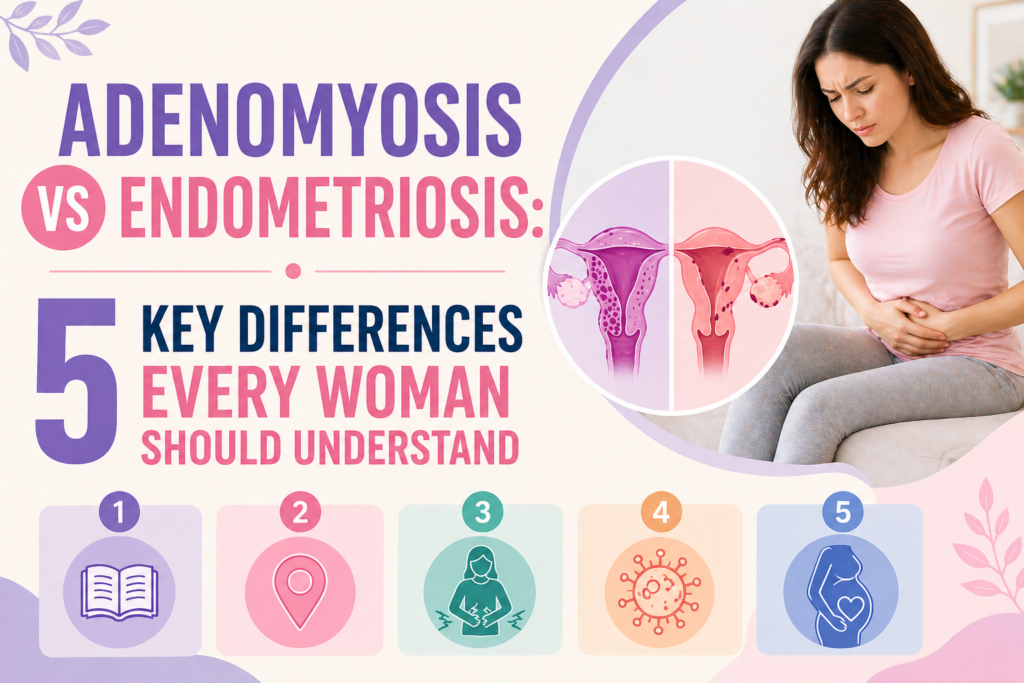
Painful periods, heavy bleeding, difficulty conceiving — if you have these symptoms, your gynecologist in Kolkata may mention two conditions: adenomyosis vs endometriosis. They sound similar, share overlapping symptoms, and can even exist together. But they are different diseases that affect different parts of your body and may need different treatment approaches.
Understanding the difference between adenomyosis vs endometriosis matters because the wrong diagnosis leads to the wrong treatment — and years of unnecessary suffering. Here are 5 key differences explained simply.
Difference 1: Where the Tissue Grows
This is the most fundamental distinction between adenomyosis vs endometriosis.
In adenomyosis, tissue similar to the uterine lining grows INTO the muscular wall of the uterus itself. The uterus becomes enlarged, heavy, and swollen. The tissue never leaves the uterus.
In endometriosis, similar tissue grows OUTSIDE the uterus — on the ovaries, fallopian tubes, pelvic lining, bowel, bladder, and in severe cases, on the pelvic nerves. These misplaced growths bleed with every menstrual cycle, causing inflammation, scarring, and adhesions.
Think of it this way: adenomyosis is an invasion inward. Endometriosis is an invasion outward.
Difference 2: Who It Typically Affects
Adenomyosis is more commonly diagnosed in women in their 30s and 40s, particularly those who have had children or uterine surgery (including C-sections). The average age at diagnosis is 40-50 years.
Endometriosis typically begins earlier — symptoms often start in the teenage years or early twenties. It affects roughly 1 in 10 women of reproductive age. The average delay in diagnosis is 7-10 years because period pain is widely normalised, especially in India.
You can have both conditions simultaneously. Studies show approximately 40% of women with adenomyosis also have endometriosis.
Difference 3: How the Pain Feels
Both cause pelvic pain, but the pattern differs.
Adenomyosis pain is centered in the uterus — deep, cramping pain during periods, a constant dull ache or heaviness in the lower abdomen, and pain during intercourse. The uterus feels heavy and swollen. Bleeding is extremely heavy — often gushing — with large clots.
Endometriosis pain is more varied because the tissue can be anywhere in the pelvis. It includes severe period pain that worsens over time, pain during bowel movements or urination during periods, pain during intercourse, and chronic pelvic pain between periods. If endometriosis affects the pelvic nerves, it can cause leg pain, sciatica during periods, and burning or shooting sensations.
Difference 4: How They Are Diagnosed
Adenomyosis can usually be diagnosed with a transvaginal ultrasound or MRI showing a thickened, enlarged uterus. It does not always require surgery to confirm.
Endometriosis is harder to diagnose. Ultrasound can detect ovarian endometriomas (chocolate cysts) but often misses smaller implants. The gold standard for diagnosis is laparoscopic surgery — a minimally invasive procedure where the surgeon directly visualises endometriotic tissue in the pelvis.
This is why seeing an endometriosis specialist matters — a general gynecologist may not look beyond the ultrasound.
Difference 5: Treatment Approaches
For adenomyosis: Pain management with NSAIDs, hormonal treatment (birth control pills, IUD), and in severe cases, hysterectomy — which is the only definitive cure for adenomyosis since the disease is within the uterine wall itself.
For endometriosis: Medical management with hormonal therapy, plus laparoscopic excision surgery to remove the endometriotic tissue. Excision (cutting out) is superior to ablation (burning). For deep infiltrating endometriosis involving nerves or bowel, robotic surgery provides additional precision.
Dr. Juhi Dhanawat is an endometriosis specialist in Kolkata with Fellowship training from France and a Masters in Neuropelveology from Switzerland — meaning she can handle both standard and nerve-involving endometriosis. She consults at Neotia Bhagirathi, Rawdon Street and New Town, and Motherhood Hospital, Kasba, Kolkata.
If you are experiencing heavy painful periods, chronic pelvic pain, or difficulty conceiving — do not wait years for a diagnosis. See a specialist who can tell the difference.
Frequently Asked Questions
Q: Can I have both adenomyosis and endometriosis at the same time? A: Yes. Studies show approximately 40% of women with adenomyosis also have endometriosis. Having both can make symptoms more severe and diagnosis more complex. A specialist evaluation with imaging and possibly laparoscopy can identify both conditions.
Q: Which is more painful — adenomyosis or endometriosis? A: Both can be severely painful. Adenomyosis tends to cause heavier bleeding and more cramping centered in the uterus. Endometriosis pain is more widespread and can affect the bowel, bladder, and nerves. Severity depends on the extent of disease in each individual.
Q: Can adenomyosis or endometriosis cause infertility? A: Both can affect fertility. Endometriosis can damage ovaries, block tubes, and create a hostile pelvic environment. Adenomyosis can affect implantation because of the thickened uterine wall. With proper treatment from a specialist, most women can conceive.
Q: Does hysterectomy cure endometriosis? A: Hysterectomy cures adenomyosis because the disease is in the uterus. But hysterectomy does NOT cure endometriosis because the tissue exists outside the uterus. Endometriosis requires separate surgical excision of the implants.
Q: Who should I see for diagnosis — adenomyosis vs endometriosis? A: A gynecologist with specific expertise in both conditions. Fellowship-trained endometriosis surgeons who also understand adenomyosis can provide the most accurate diagnosis and treatment plan.
Dr. Juhi Dhanawat — Gynaecologist, Endometriosis Specialist & Neuropelveology Expert. Consults at Neotia Bhagirathi, Rawdon Street and New Town, and Motherhood Hospital, Kasba, Kolkata.
Book a consultation: Call +91 8240886334 or visit drjuhidhanawat.in/book-anappointment/